If you have been researching business management software, you have almost certainly come across both CRM and ERP. These terms are often used interchangeably, but they are fundamentally different tools designed to solve different business problems.
Investing in the wrong one can waste significant time and money. Here is a clear, practical breakdown to help you make the right decision.
What is a CRM System?
CRM stands for Customer Relationship Management. A CRM system is designed to manage your relationship with existing and potential customers. It tracks every interaction — calls, emails, meetings, proposals, and deals — giving your sales and marketing team a complete view of each customer's journey.
Core features typically include: lead management, contact database, sales pipeline tracking, follow-up reminders, email communication logs, and sales performance reports.
Who needs a CRM? Any business that depends on sales — agencies, real estate firms, service providers, B2B companies, e-commerce stores with high repeat customers. If your team manages more leads than they can remember without a system, you need a CRM.
What is an ERP System?
ERP stands for Enterprise Resource Planning. An ERP system integrates and manages your core business operations — finance, inventory, human resources, procurement, manufacturing, supply chain, and more — in a single unified platform. The goal is to give you a real-time view of your entire business in one place.
Core features typically include: accounting and financial management, inventory and warehouse management, purchase order management, HR and payroll, production planning, and business intelligence reports.
Who needs an ERP? Manufacturing companies, trading and distribution businesses, businesses with multiple departments that currently use separate systems, and any company where financial, inventory, and operational data needs to be synchronized in real time.
The Key Differences at a Glance
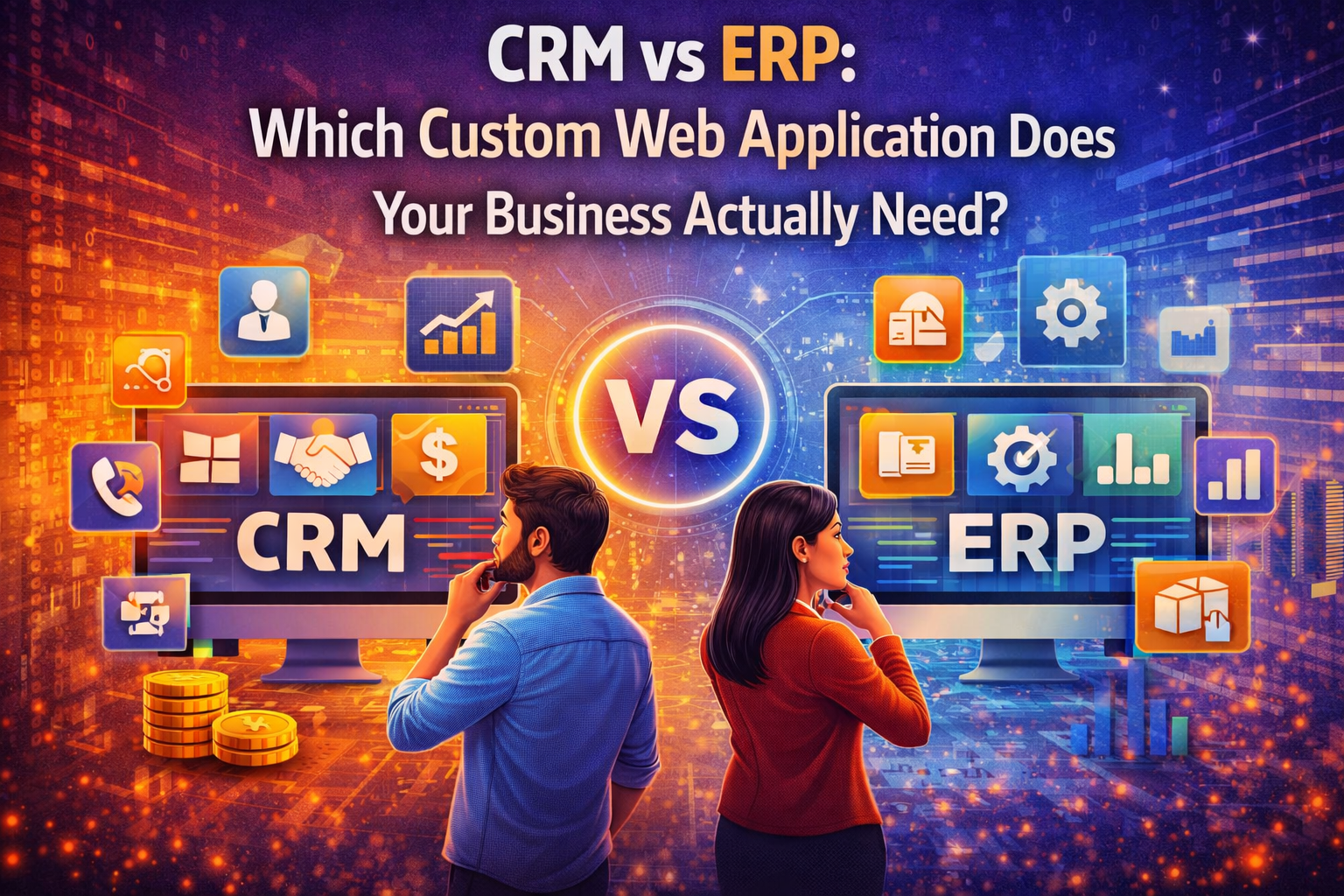
CRM focuses outward — on your customers, leads, and sales pipeline. ERP focuses inward — on your internal business operations and resources. A CRM helps you win more customers. An ERP helps you serve them efficiently and manage your business profitably.
Can You Use Both Together?
Absolutely — and many growing businesses eventually do. A CRM handles customer acquisition while an ERP manages order fulfillment, inventory, and finance. When integrated, they provide a seamless flow from lead generation all the way to delivery and invoice, eliminating data silos and manual data entry between systems.
Custom vs Off-the-Shelf Software
Generic CRM tools like Salesforce, HubSpot, or Zoho and ERP tools like SAP or Tally work well for many businesses. However, if your business has unique processes, industry-specific requirements, or needs integration with your existing systems, a custom-built solution is often more cost-effective in the long run — with no monthly subscription fees, no unnecessary features, and workflows designed exactly around how your team actually works.
Conclusion: Start With the Problem You Are Solving
The answer to "CRM or ERP?" depends entirely on where your biggest pain point is right now. If you are losing leads and struggling with sales follow-ups — start with a CRM. If your inventory is chaotic, your finances are disconnected, and your operations are inefficient — start with an ERP.
At DigitalDuniya, we build custom CRM and ERP systems tailored to your specific business needs — with no bloat, no unnecessary features, and no monthly subscriptions. Contact us today for a free requirements discussion.
🚀 Ready to Grow Your Business Online?
Let us help you build a professional, high-converting website tailored to your business needs.
Get Your Website / App NowContact us today and take your business to the next level in 2026.